UnMySt – Unravelling the Mysteries of Vibrational Strong Coupling
UnMySt is an
international research project that explores how vibrational strong coupling in
optical cavities can be used to steer chemical reactivity and material
properties. Our goal is to transform polaritonic chemistry into a practical
tool in synthetic chemistry and material design. The project is funded by the
European Research Council under the Synergy Grant Scheme, and it unites leading
experimental and theoretical groups in polaritonic chemistry.
Vibrational strong coupling has
emerged as a powerful way to modify materials and ground chemical reactivity,
even in the absence of light. While the scientific and technological potential
is clear, the underlying mechanisms driving these changes remain a mystery.
UnMySt aims to solve this puzzle, moving from simple observations to a
predictive framework. Over the six-year period of the project, we will jointly
pursue these key questions:
Local vs. collective reactivity: How do local reaction coordinates
couple to delocalized polaritonic modes?
Equilibrium properties: To what extent do thermodynamic and
structural properties change in a cavity?
Non-equilibrium dynamics: How are solvent reorganization, charge
and energy transfer modified under VSC?
Symmetry and design: Can cavity-imposed or broken symmetries be
used to enhance or suppress specific reaction pathways?
The UnMySt Team
The UnMySt project employs
a multifaceted approach, merging experimental and theoretical efforts to bridge
the conceptual gaps presented by vibrational strong coupling and polaritonic
chemistry. Our international consortium comprises four distinct nodes, each
contributing complementary methodologies and perspectives:
Strasbourg Group: Led by
Thomas Ebbesen who
envisioned and pioneered the field of polaritonic chemistry, this node explores
chemical reactivity under Vibrational Strong Coupling (VSC). A key focus of
these studies is the role of molecular and electromagnetic symmetries,
spearheaded by
Cyriaque Genet.
Tel Aviv Group: Led
by
Tal Schwartz, this node focuses
on ultrafast time-resolved spectroscopy measurements. In collaboration with
Sharly Fleischer, the group probes dynamics across the entire spectral range,
spanning the visible, mid-infrared, and Terahertz regimes.
Hamburg Group: Led
by
Angel Rubio and based at
the Max Planck Institute for the Structure and Dynamics of Matter, this node
develops ab initio simulations of strongly coupled materials. This work
leverages the expertise of
Michael Ruggenthaler in mathematical modeling and
Dominik Sidler in
simulations of non-canonical VSC systems.
Pennsylvania Group: Led by
Abraham Nitzan at U. Penn, this node focuses on macroscopic classical and
semiclassical modeling, including the formulation of novel reaction-rate
theories adapted for VSC. This effort utilizes state-of-the-art
Maxwell–Schrödinger simulations, developed together with
Maxim Sukharev at
Arizona State University.
News & Highlights
New Publication:
Molecular Polariton Dynamics in Realistic Cavities.
A cost-effective computational method is
introduced, combining Maxwell’s equations with quantum molecular dynamics to
simulate how large groups of molecules interact with light inside realistic
mirrored cavities. This approach allows to observe how the position and
orientation of individual molecules influence both collective light signals and
unique local chemical responses.
New Publication:
Effective equilibrium theory of quantum light-matter interaction in cavities for extended systems and the long wavelength approximation.
This publication establishes an effective,
non-perturbative ab-initio theory for Fabry-Pérot cavities that simplifies
quantum light-matter interactions in extended 2D systems by reducing a complex
continuum of electromagnetic states into a few discrete photonic modes. Most
importantly, it is demonstrated that the interaction volume remains finite even in the bulk limit.
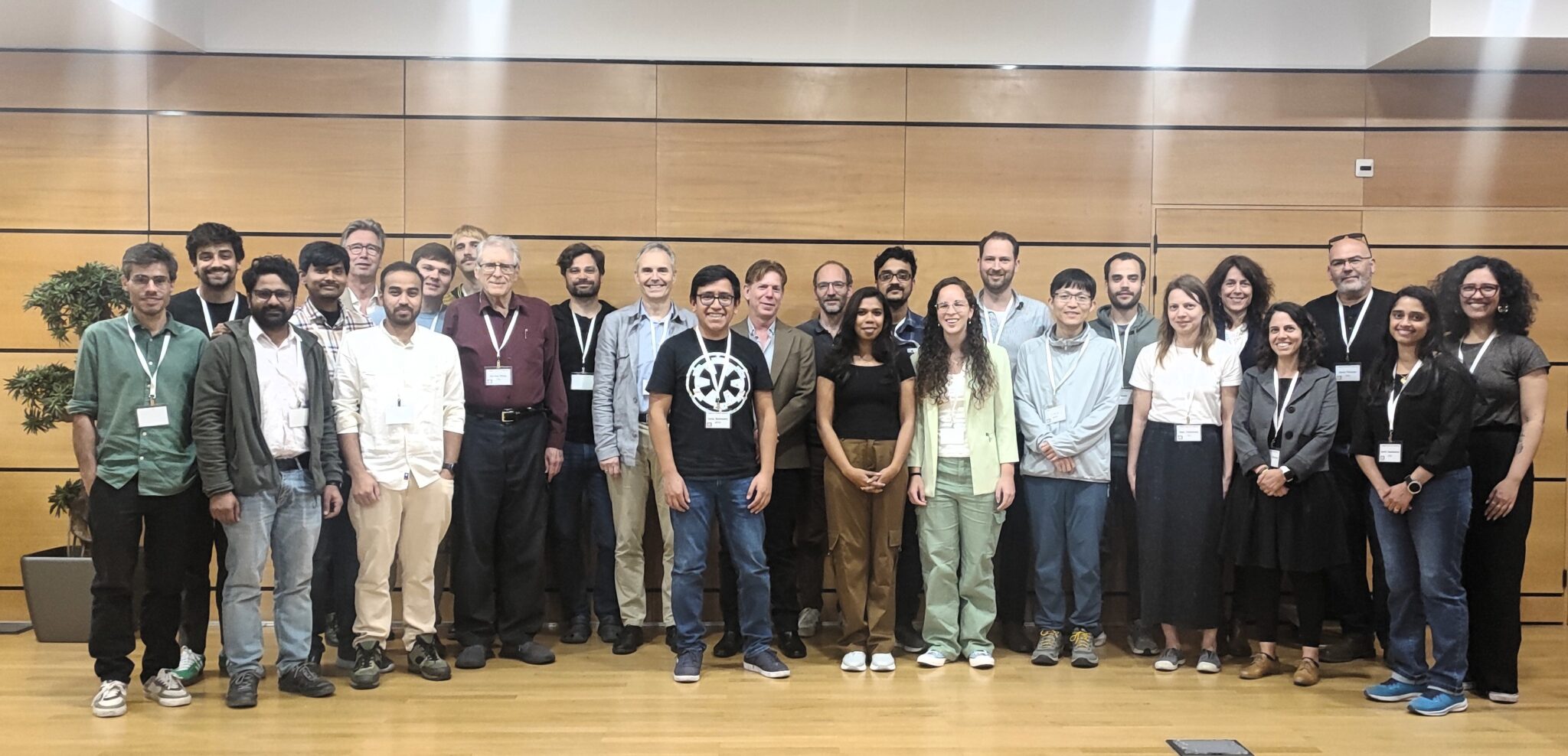
A stimulating beginning: The UnMySt Synergy Project was officially launched in a kick-off meeting held
in Strasbourg on 20-22 May, 2025. It was an opportunity for all the
participants to meet and start to know each other, their skills and projects,
and to define together the way we would like to handle the next meetings and
the topics to target for the future.