In nature, light and matter are constantly interacting – photons are absorbed or emitted, they induce chemical reactions and drive the transport of charges. When such interactions occur inside a wavelength-scale region confined by a photonic nanostructure they can change dramatically, giving rise to new and exciting
effects. In our research, we explore artificial structures with which we may produce complex materials with new properties and control the interaction of light and matter. We focus on several aspects of this theme, which lie at the meeting point of chemistry, quantum physics, optics and materials science.
For complete publications' list see Google scholar
Cavity-Enhanced Transport:
In one of
our main research directions, we tackle a major limitation of organic
materials: their inability to transport energy and charge carriers over long
distances. By strongly coupling organic molecules with light, we created hybrid
particles called exciton-polaritons that essentially inherit the
properties of photons, in addition to their partly-excitonic nature. We used
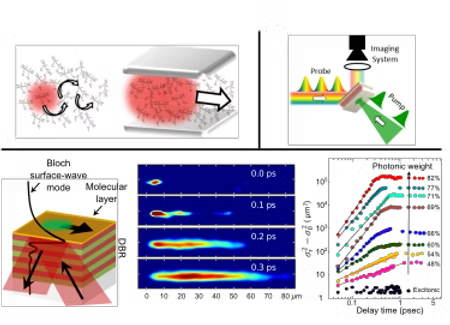
ultrafast microscopy to track these particles in real-time, revealing that they
don't just "hop" slowly from molecule to molecule, as normally
occurs. Instead, they can travel ballistically, flying in straight lines
like bullets, and at speeds close to the speed of light.
Long-range transport of organic exciton-polaritons revealed by ultrafast microscopy
GG Rozenman, K Akulov, A
Golombek, T Schwartz
ACS Photonics 5 (1),
105-110
From enhanced diffusion to ultrafast ballistic motion of hybrid light–matter excitations
Mukundakumar
Balasubrahmaniyam, Arie Simkhovich, Adina Golombek, Gal Sandik, Guy Ankonina,
Tal Schwartz
Nature Materials 22 (3),
338-344
 listen to the AI talk about this topic
Strong Coupling in Multimode Cavities:
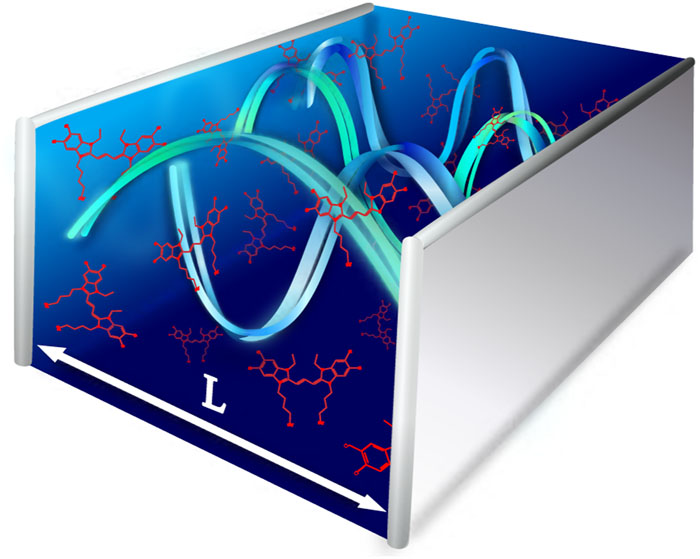
By investigating multimode cavities which are thick
enough to support multiple optical resonances, we discovered a fundamental, new
type of transition occurring for light-matter interaction. We revealed that the
finite speed of light plays a crucial, often overlooked role: when a cavity is
large enough, the time required for light to travel across it begins to compete
with the incredibly fast energy relaxation of the molecules. This competition
dictates whether the different light modes are "entangled" by their
interaction with the molecules, or remain independent. Following our
theoretical prediction of this phenomenon, we confirmed its existence
experimentally, demonstrating that simply increasing the cavity thickness can
drastically alter the nature of the resulting polaritons. These findings
challenge the conventional view that the behavior of hybrid light-matter
systems depends solely on the interaction strength.
Coupling and decoupling of polaritonic states in multimode cavities
M. Balasubrahmaniyam,
Cyriaque Genet, and Tal Schwartz
Physical Review B 103,
L241407 (2021)
Exploring the nature of high-order cavity polaritons under the coupling-decoupling transition
M. Godsi, A. Golombek, M.
Balasubrahmaniyam, T. Schwartz
The Journal of Chemical
Physics 159, 134307 (2023)
Extending Polaritonic Chemistry to Terahertz Frequencies:
We pushed the boundaries of
light-matter strong coupling into an entirely new realm: the low-Terahertz
(THz) frequency region. While previous work focused on coupling light to the
internal vibrational modes of molecules, in this paper, we successfully achieved
strong coupling with collective, inter-molecular vibrations. These are
the concerted, low-frequency motions where entire groups of molecules move
together - a dynamic that is fundamental to the function of biological
structures like proteins, as well as the mechanical properties of polymers and
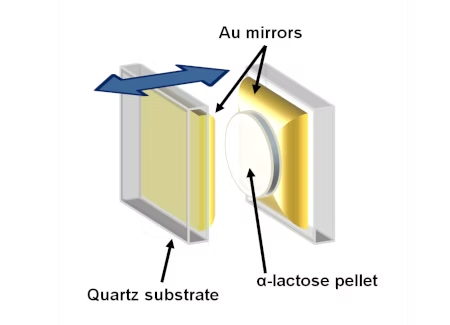
other large material systems. By placing organic crystals like a-lactose inside a THz
cavity, we successfully created hybrid excitations (vibro-polaritons) and
directly observed their coherent Rabi oscillations in the time domain,
confirming the emergence of strong coupling and reversible light-matter
interaction. This breakthrough expands the potential of polaritonic chemistry
to control the collective dynamics that govern a vast array of chemical and
biological processes.
Strong coupling of collective intermolecular vibrations in organic materials at terahertz frequencies
Ran Damari, Omri Weinberg,
Daniel Krotkov, Natalia Demina, Katherine Akulov, Adina Golombek, Tal Schwartz,
and Sharly Fleischer
Nature Communications 10, 3248 (2019)